Brazil’s DNA: The Most Genetically Diverse Country in the World?
- ArtLeo Art
- Apr 2
- 5 min read
BY LEO MACIEL
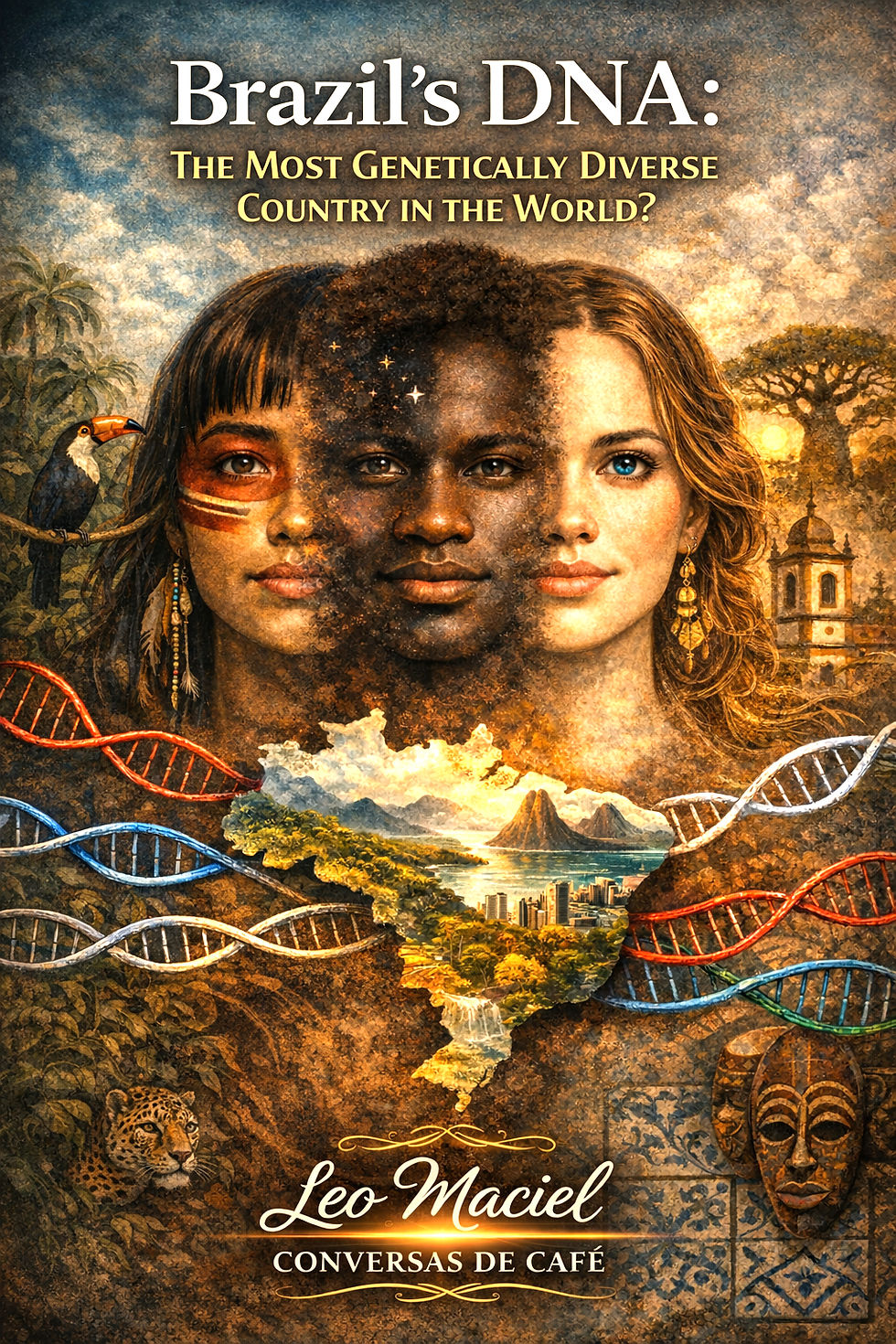
In this new Conversa, Leo Maciel begins from a recent scientific discovery to reflect on the deeper formation of Brazil — not only as a territory, but as a body.
By exploring the country as one of the most genetically diverse populations in the world, the essay moves through history, identity, and memory, revealing how encounters, displacements, and asymmetries remain inscribed within us.
More than a reflection on genetics, this text proposes a different kind of listening: to what the body carries, even when history did not tell it.
There are stories that do not arrive through books. They arrive through the body.
Through silent lines that travel across generations, through traits we did not choose, through memories we do not remember — and yet still inhabit us. Sometimes, all it takes is a scientific study to reveal what has always been there, in plain sight, but never fully said.
That is what happened when Brazilian researchers sequenced thousands of genomes and discovered something that, perhaps, we already knew: Brazil may be the most genetically diverse country in the world. Not by chance, But by history.
By encounters — many of them violent — that left deep marks. By forced displacements, improbable survivals, and mixtures that took place long before they were celebrated as identity.
And perhaps what is most striking is not the discovery itself.But the way it reorganizes what we thought we knew.
The Body as a Living Archive
When we look at Brazilian DNA, we are not just seeing numbers. We are seeing a map.
A map in which 71% of paternal lineages are European. And where, at the same time, 42% of maternal lineages are African, and 35% are Indigenous. It is difficult not to feel a certain weight in that.
Because these percentages are not statistics — they are testimonies. Testimonies of a country shaped by European men and African and Indigenous women. Testimonies of asymmetries that still echo. Testimonies of a history the body preserved even when collective memory tried to forget.
The body records.Even when no one narrates. And perhaps that is why Brazilian DNA feels so vast: it is not only a biological inheritance — it is a historical archive. An archive that was never written. But never ceased to exist.
A Mixture That Is Not a Metaphor
To say that Brazil is mixed has always sounded like a ready-made phrase.
But genetics shows that this mixture is not an abstract idea — it is literal.
It is in the blood, the skin, the bones. It is in genetic variants that exist only here — millions of them, previously unknown, invisible to the world until now. Variants that do not appear in European databases, because Brazil is not an extension of Europe. Nor of Africa. Nor of Indigenous America.
It is an encounter of worlds. An unequal encounter — but still an encounter.
And each region carries that encounter in its own way: the North more Indigenous, the Northeast more African, the South and Southeast more European.
But these differences, when observed closely, begin to dissolve. Be use what is striking is not only the variation between regions.It is the variation within them.
Individuals who identify in similar ways may carry very different genetic compositions. And, conversely, people with similar genetic histories may be perceived — and perceive themselves — in entirely different ways.
No one is just one thing.No one is pure. No one belongs entirely to one side.
Brazil is one of the few places where three continents meet within the body so deeply.
And that is not just a characteristic. It is a condition.
What Science Reveals That History Did Not Tell
There is something deeply poetic — and deeply tragic — in the fact that the body preserved what history erased. While Indigenous languages disappeared, while no African languages survived among the descendants of enslaved people in the same way, while documents were lost, DNA remained — silent, holding everything.
Holding what we were. Holding what we still are. Holding what was taken — but not entirely removed.
Science, in this case, does not correct history. It illuminates it. It shows that behind the official narrative, there was always another story — more complex, more human, more difficult to organize.
And perhaps more uncomfortable. Because the study reveals something we rarely say out loud: Brazilian miscegenation was not a romantic process.
It was, to a large extent, shaped by violence. And the body still carries that mark.
Not as conscious memory. But as continuity.
Between What We Are and What We Think We Are
There is a dissonance that is difficult to ignore. Between what the body carries,what history has told,and what we have learned to say about ourselves.
Brazil is often described as a country of mixture. And for a long time, that idea was sustained as a sign of coexistence, integration, even harmony. But when that mixture is observed more closely, it loses its simplicity.
It gains texture. It gains direction. It gains history.
And with that, it also loses some of its innocence. This does not diminish what was created. On the contrary — it expands it.
Because what exists today is not only the result of imposition.
It is also the result of adaptation, survival, and creation.
Cultures that reinvented themselves.Languages that transformed.Ways of living that emerged under conditions that were not chosen — and yet still produced a world.
The Country Where the World Meets
Perhaps the most beautiful — and most difficult — realization is this:
Brazil is not a country that came from one place.
It is a country that came from many. And this multiplicity is not a weakness. It is a density.
The study shows that we are a mosaic of haplotypes from different parts of the world.
That we carry, within our bodies, traces of peoples who never met each other — but met within us. And this has profound implications — for science, for medicine, for how we understand disease, treatment, biological responses.
But also for something less measurable: Identity.
Because perhaps to be Brazilian is this: not to belong to a single origin,but to sustain many.
The Future Inscribed in the Past
The study reveals something even more unsettling: Brazilian mixture has not stopped.
But it has changed form.
After centuries of asymmetrical encounters, Brazil now seems to be moving toward something else: a tendency for people to form relationships with others who are more similar to themselves. A quieter movement. Less visible.
But one that raises important questions.
Are we becoming less mixed?
Is inequality still shaping who meets whom?Is what marked the past continuing — in another form — to shape the future?
Genetics does not answer. But it exposes.
The Body as Survival
Among the most fascinating findings are genes related to fertility, immunity, and metabolism. Signs of ancient adaptations that remain present.
African genes associated with resistance to tropical diseases.Indigenous genes linked to survival in extreme environments.European genes related to specific ways of metabolizing food.
The Brazilian body is not only the result of encounters.
It is also a field of adaptation.
A body that learned to cross. To endure. To transform. To continue.
What Remains
In the end, what this study reveals is not only genetic diversity. It is memory.
Memory of Indigenous peoples who resisted erasure.Memory of Africans who survived the impossible.Memory of Europeans who arrived and left deep marks.Memory of encounters that shaped an entire country.
And perhaps that is why, at times, Brazil seems larger than its geography.
Because it is not only a territory. It is a living history.
A history written in the body of every person born here.
A history that does not depend on remembering.
Because it never stopped being present.
***
— Leo Maciel © 2026
Conversas de Café


Comments