The Arab World That Remained in Northeastern Brazil & the Algarve
- ArtLeo Art
- Mar 30
- 5 min read
Updated: Mar 31
BY LEO MACIEL

In this new Conversa, Leo Maciel traces the quiet presence of Arab influence in the Algarve and in Northeastern Brazil — not as something formally introduced, but as a heritage absorbed into everyday life.
Through architecture, landscape, language, and lived practices, the essay reveals how these layers have crossed centuries and geographies, transforming along the way.
Rather than mapping origins, the text invites a closer way of seeing — attentive to what remains, even when it is no longer named.
There are places that seem to carry more than one history at once. Not in an obvious way. But in the details. In the way light enters through windows. In the thickness of walls. In how space is arranged between inside and outside.
When I first arrived in the Algarve, years ago, even before deciding to live here, something caught my attention almost immediately. It wasn’t a sense of belonging — as sometimes happens. It was something else. A quieter recognition.
The houses in Mediterranean tones — ochres, soft pinks, blues. The internal courtyards.The shadows designed to protect from the sun. The almond trees, the fig trees, the carob. There was a coherence that felt old. As if that way of building and inhabiting space had not emerged from that place alone.
Over time, this feeling began to take shape — not as an answer, but as a direction. Because, at certain moments, the Algarve seemed less isolated than it appeared. As if it were in dialogue with other places, other memories, other climates.
Al-Gharb: The Gateway Through Which It All Entered
For nearly five centuries, this region was known as Al-Gharb — the West. There, Arab presence was not only political.It was domestic, agricultural, architectural. It was part of everyday life.
Water wheels that moved water, citrus orchards, narrow streets that hide from the sun, rooftop terraces where the wind seems to rest — all of this formed a way of living that settled into time.
And when Portugal crossed the Atlantic, it carried more than language or administration. It carried these layers. Already transformed, already mixed but often invisible.
The Sertão as a Distant Mirror
It was in Northeastern Brazil that this sensation found another point of support. Not as repetition. But as echo.
The sertão, with its dry landscape, its resilient vegetation, its constant relationship with scarcity, holds something that resonates with older territories. This is not to say they are the same. But there is a proximity that is difficult to explain through geography alone.
And there, unlike in the Algarve, houses do not withdraw into soft tones. They assert themselves in vivid colors — yellows, reds, blues, greens — as if the intensity of light demanded contrast. As if color itself were also a form of resistance.
Architectures in Conversation
The ways of building, however, carry a quieter continuity. In the Algarve, houses close outward and open inward. In Northeastern Brazil, particularly in hotter regions, similar solutions emerge: ways of dealing with heat, with the intensity of sunlight, with airflow.
There is something in the very organization of space. In the relationship between interior and exterior. In the importance of boundaries. In how the environment is shaped to make life possible under demanding conditions.
Landscapes That Inherit
In the landscape, this continuity appears differently. The crops of the Algarve — almonds, figs, carob, citrus — carry histories that did not begin there. They traveled, were introduced, adapted, and integrated.
In the Northeast, other species occupy that space, but the logic of resistance remains.
Sounds That Cross Centuries
And in music, this connection appears in a more unexpected way. The pandeiro, the rabeca, baião, coco — rhythms that today feel deeply Brazilian — carry Arab-Andalusian echoes. Repente, with its rapid improvisation, recalls the zajal.
Aboio, the long call used to guide cattle, holds a distant kinship with the azan, the call to prayer.
None of this arrived as declared influence. It arrived as life. As practice. As a response to climate, to daily life, to survival.
Language as an Ancient House
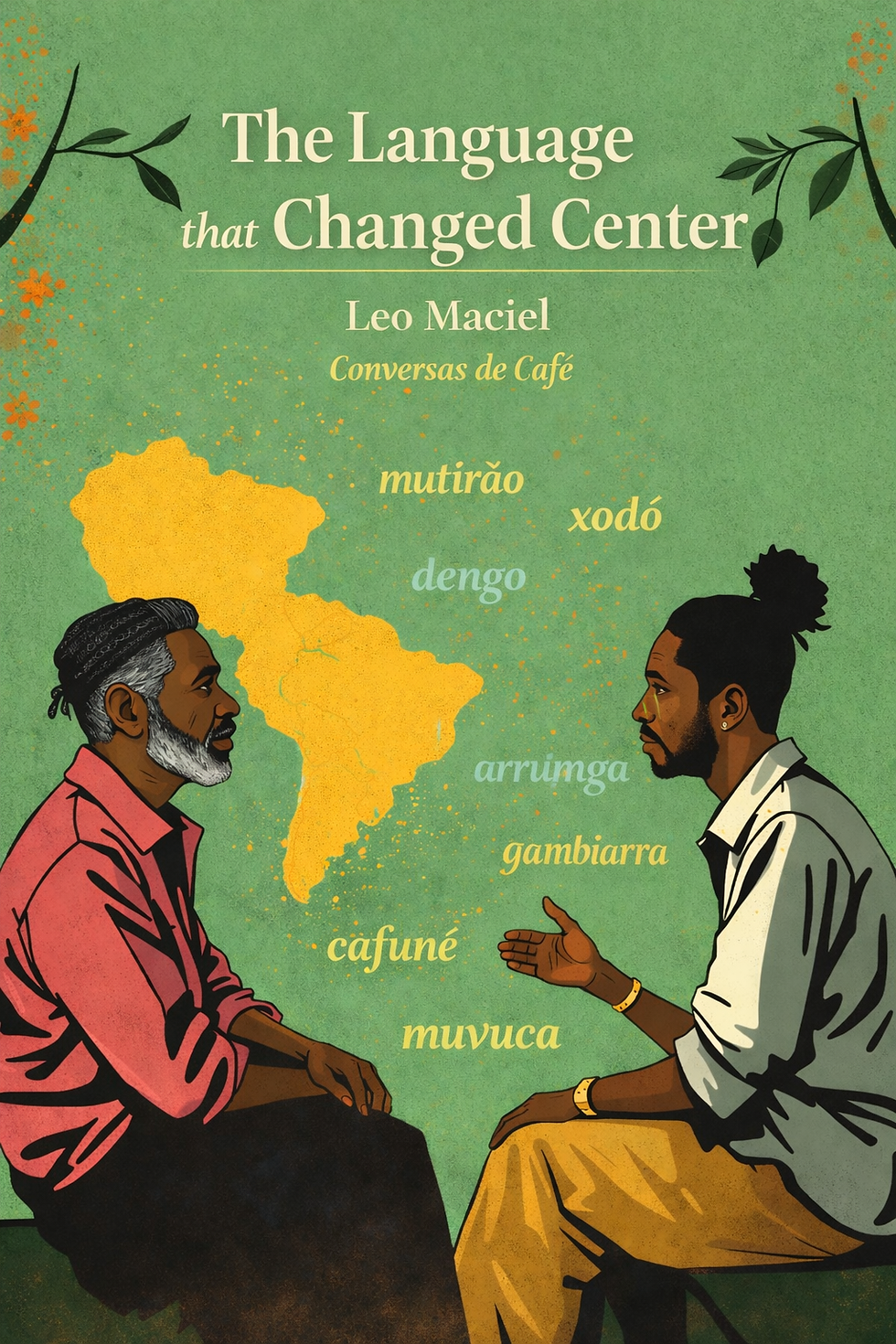
In language, this presence appears in a curious way — and almost always unnoticed. Not in the same way in European Portuguese, where many of these words did not remain as present, but in Brazilian Portuguese, which preserved around a thousand terms of Arabic origin. It is as if the language carries its own memory.
Many of these words hold a subtle trace: al- — an article which, in Arabic, simply means “the”. In Brazil, it appears in words we use without thinking: sugar, rice, olive oil, pillow, cotton, warehouse. Terms that feel Brazilian — and are — but carry within them a much longer journey.
And sometimes this crossing appears within a single word.
In Brazil, “oxalá” carries two histories that never met, yet came to be written in the same way. As an expression — “hopefully”, “God willing” — it comes from Arabic expressions such as wa shā’ Allāh and in shā’ Allāh, which crossed centuries before becoming adapted into Portuguese. But “Oxalá”, the orixá in Afro-Brazilian religions, has a Yoruba origin, from Òrìsà Nlá, “the great orixá”.
Two distant roots.Two different worlds. One shared word.
Perhaps it is this coincidence — this unexpected overlap — that best reveals how cultures meet: not by intention, but through coexistence.
Ways of Dwelling, Ways of Remembering
And this heritage does not remain only in language. It appears in the ways we build and inhabit.
In the muxarabis that crossed centuries before becoming wooden latticework in colonial windows of Northeastern Brazil. In the tiles — from az-zulayj — that turned Portuguese and Brazilian façades into mosaics of geometry and light. In internal courtyards, in fountains, in the idea that water — when it exists — should be celebrated.
What Remains Without Being Named
But what matters most is not identifying each element. Nor proving each origin.
It is perceiving how these influences become part of something new. How they cease to be external and become part of the very fabric of who we are.
Between the Algarve and the Northeast, what appears is not repetition. It is transformed continuity.
And this suggests something deeper about culture: that it rarely emerges in isolation. That it is built through encounters, movements, and layers.
What we call “local” is often made of what has traveled from afar. And, once it arrives, it no longer feels foreign.
Perhaps that is why certain places feel familiar without us knowing exactly why. Not because we have been there before. But because something there has already been in us.
Resonances
In the Algarve, this perception appears in softened tones, in shadows, in trees that endure heat. In Northeastern Brazil, it appears in the landscape, in built solutions, in ways of inhabiting space. Not as imitation.But as resonance.
And perhaps it is not necessary to go much further than this. Nor to organize everything into complete explanations. It is enough to perceive that some histories remain present, even when they are no longer told.
And that, at times, to understand a place is not only to know its history but to perceive the other histories it still carries.
***
— Leo Maciel © 2026
Conversas de Café


Comments