The Body as a Place of Memory
- ArtLeo Art
- Mar 16
- 4 min read
By Leo Maciel
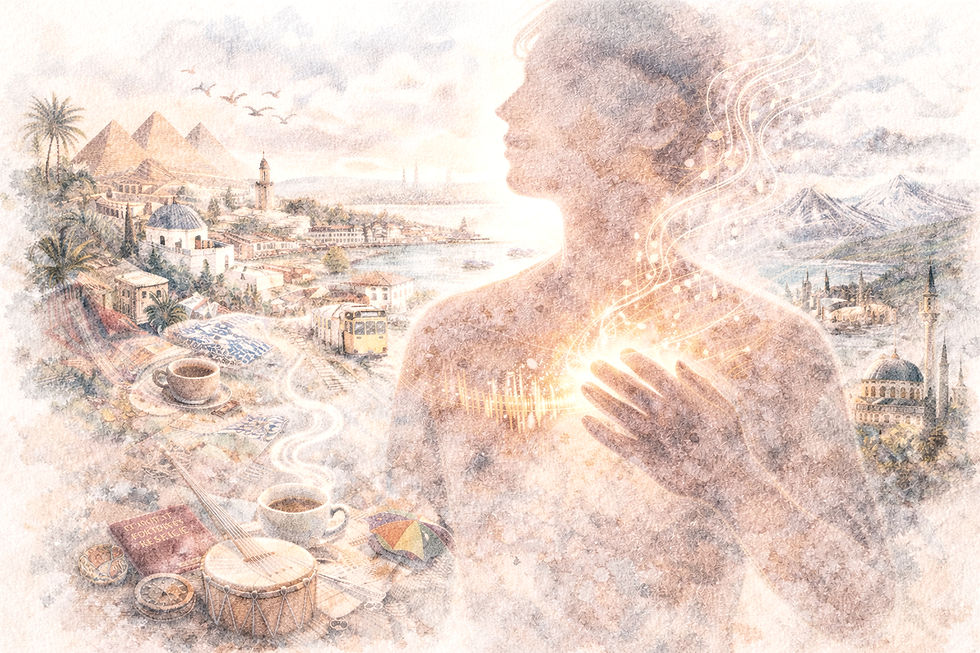
Memory is often imagined as something we can retrieve — a photograph in the mind, a story we can retell, a past we can organise into words. Yet much of what shapes us does not return in this way. It returns as sensation.
In this new Conversa, Leo Maciel reflects on the body as a living archive of experience — a place where climates, rhythms, languages, encounters, and landscapes continue to resonate long after we have left them behind. Moving between continents and cultures, he explores how memory is not only narrated but enacted: in posture, gesture, breath, and the subtle recognition of atmospheres that feel like home.
This essay opens a new path within Conversas de Café — one that moves beyond cultural observation into embodied reflection. It invites the reader to consider memory not as something stored in the past, but as something that continues to live in the present, shaping how we inhabit the world.
Because perhaps the most important question is not only where we come from —but what landscapes continue to live within us.
There are memories we preserve in photographs. Others we shape into language — narrated, revised, shared across time.
But there are also memories that do not return as images or stories.
They return as sensations.
A certain rhythm reaches your ears, and your foot responds before thought arrives.A familiar warmth in the air softens your breathing without explanation.You hear your mother tongue after weeks of speaking another language — and your voice changes register, as if rediscovering an older architecture of sound.
We often imagine memory as something we “retrieve,” like an object stored somewhere in the mind.
Yet much of what we call remembering is not retrieval at all.It is re-enactment.
Life leaves traces not only in what we can consciously recall, but in how we move, how we gesture, how we inhabit space. Past experience becomes sedimented in posture, rhythm, expectation, sensitivity to atmosphere. The body becomes a quiet archive of lived history.
Distance makes this especially visible.
When we leave the places that formed us, the mind gradually adapts — learning new routes, new climates, new languages of belonging. But the body continues to recognise what it has known before. It carries an implicit cartography: of streets walked in youth, of celebrations entered without hesitation, of ways of greeting shaped by culture and time.
You may forget the exact name of a square where you once stood laughing with friends.But you do not forget how your body felt standing there — the light tilting at the end of the afternoon, humidity gathering on the skin, music approaching from somewhere you could not yet see.
Sometimes, across the ocean, a fragment of sound or smell or temperature opens a passage.
Frevo brass cutting through distant air.A drum pattern that travels through the chest before the intellect can identify it.The scent of food that collapses decades into a single breath.
These moments are not simply nostalgic.They reveal that memory is not confined to narrative recollection. It also lives in learned rhythms, in cultural gestures, in shared ways of occupying public space. What has been lived repeatedly becomes incorporated — shaping how we respond to the world long after we have physically left the environments where those responses were formed.
For those who live between cultures, this embodied memory becomes a form of orientation.
Home is no longer only geographical.It becomes atmospheric.
A constellation of recognitions: a certain pace of conversation, a way laughter expands in open streets, the permission to move differently among people whose bodily language resembles your own. Even joy carries an accent.
We often speak of identity as something we construct through ideas, affiliations, and conscious choices. But identity is also enacted through the body’s accumulated habits — ways of standing, listening, dancing, waiting, touching, pausing. These are not abstract traits. They are lived inheritances.
Places, too, remain present within us.
Not as static images, but as dynamic fields of sensation. A coastline remembered through the salt that once settled on the skin. A city recognised through the incline of its streets, the density of its sounds, the choreography of its crowds. When we return to such places, what we experience is not merely familiarity. It is re-alignment — the body remembering how to exist there.
This does not mean that the past remains unchanged.It never does.
Rather, it suggests that experience continues to shape us in ways that exceed conscious awareness. The body retains traces of climates, encounters, celebrations, and tensions — traces that quietly influence how we move through the present.
Perhaps this is why memory can feel sudden and visceral.A detail — light reflected on water, a voice calling from across a market, the cadence of a song — can release an entire world that had seemed dormant. Not because it was stored somewhere intact, but because it was woven into the very fabric of how we sense and respond.
To live is to be continuously inscribed by place, by relationship, by rhythm.
We carry histories not only in what we can tell, but in how we breathe, how we walk, how we recognise ourselves among others.
We often ask: Where do we come from? But another question may be just as important:
What landscapes continue to live within our bodies?
***
Written by © Leo Maciel, 2026


Comments