Sexual Violence, DNA, and the Myth of Racial Democracy in Brazil
- ArtLeo Art
- Apr 10
- 7 min read
BY LEO MACIEL

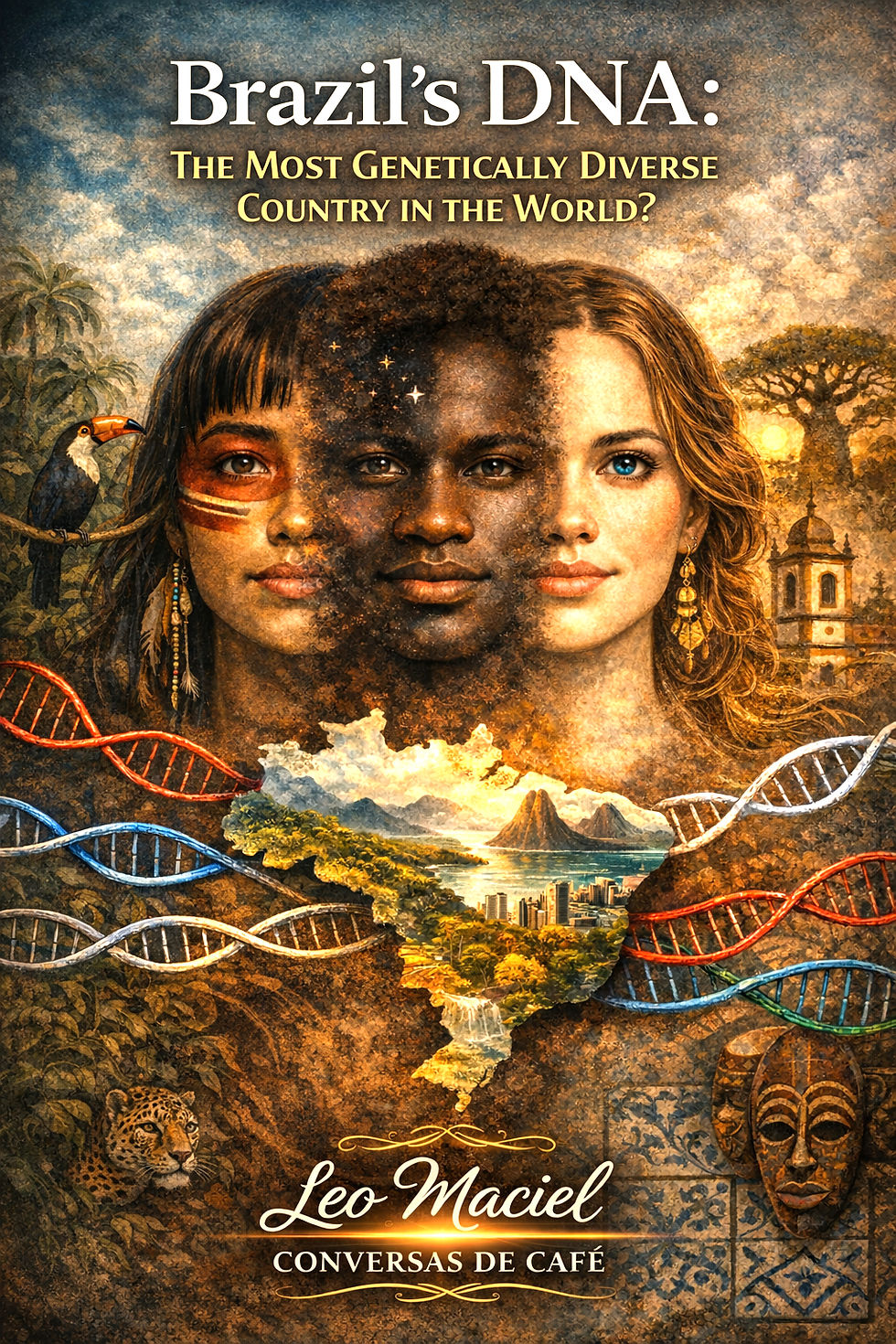
Brazil is often described as a country of mixture — a place where peoples, cultures, and histories met and blended. But what if that mixture is not the story we think it is?
Recent genetic research reveals a pattern that is difficult to ignore: overwhelmingly European paternal lineages alongside predominantly African and Indigenous maternal ones. This is not just diversity — it is structure. And structure raises a question the national narrative has long avoided:
what kinds of relationships produced this body?
In this essay, Leo Maciel brings genetics, history, and cultural memory into conversation to examine how sexual violence, power, and silence became part of Brazil’s formation — and how the myth of racial democracy helped obscure it.
When the Question Changes the Body
After writing about Brazil’s DNA, a question remained unresolved. It didn’t appear while I was writing — it arrived afterwards, when the text was already finished, as if something essential had been left outside. I was rereading the data, the diversity, the paternal and maternal lineages, and suddenly the issue was no longer about origins. It had shifted into something else.
If this is the body that emerged, then what kinds of relationships produced it?
That question changes the vantage point. Because some histories never reach us through books. They arrive through the body. Through the silent lines that cross generations, through traits we did not choose, through memories we do not recall — yet which inhabit us all the same. The body keeps what the archive lost, what language forgot, what history preferred to soften.
And perhaps that is why the word “mixing” begins to feel insufficient — not wrong, but incapable of naming what truly happened.
Before the Archive, the Body
There are moments when a country looks at itself in the mirror and realises that the reflection is not only its own, but also that of all the bodies that came before it. Brazil is one of those cases. When we speak of genetic diversity, we are also speaking of memory — not the memory written on paper, but the one inscribed in flesh. The body keeps what the archive lost, what language forgot, what history preferred to smooth over.
For a long time, the national narrative insisted on calling this mixture an “encounter”, “harmony”, “cordiality”. Miscegenation became almost a compliment, a founding myth, a comfortable explanation for Brazil’s complexity. But when we look more closely, we realise the question was never simply who mixed, but under what conditions that mixing occurred. The answer does not fit into a neat sentence — and perhaps that is why the country avoided formulating it.
Recent genetics, however, demands a new honesty. It does not tell individual stories, describe scenes, or accuse specific people. But it reveals patterns. And patterns, when persistent, are forms of memory. Brazilian DNA shows an asymmetry so consistent it resembles a signature: European fathers, African and Indigenous mothers. A mixture that did not occur at random, but according to a historical logic that predates any tropical romance.
This is where the body begins to speak in a language history tried to silence. And this is where the essay must go deeper — not to replace history with genetics, but to allow one to translate the other. Because if the body retained what the archive attempted to erase, then it is in the body that truth insists on surviving.
What DNA Says, What History Translates
There is a point at which science and history meet — and when they touch, silence becomes impossible. Recent genetic research on Brazil reveals a pattern so stark it resembles a scar: a sexually asymmetrical mixture, with overwhelmingly European paternal lineages and predominantly African and Indigenous maternal lineages. The study published in Science describes Brazil as a population “recently and unevenly admixed”, and explicitly links this pattern to the violent dynamics of European colonisation. DNA does not accuse anyone in particular, but it does not allow a romantic reading of miscegenation either. It speaks in another language — but it speaks.
History, in turn, translates that language with uncomfortable precision. Brazil’s genetic formation does not prove racial harmony; it proves the opposite. The mixture exists, yes, but it was born within a regime of radical inequality: colonisation, the Atlantic slave trade, enslavement, sexual violence, Indigenous dispossession. Brazil’s genetic landscape is made of voluntary migration and coerced migration, of encounters and of violations, of possible affections and structural impossibilities. The origin is not innocent — and the body knows it.
There is also the symbolic gesture that runs through everything: the burning of slavery records ordered by Rui Barbosa in 1890. Not everything was destroyed, but enough to force the country to learn to read itself through other means. The body became a residual archive. DNA, a surviving document. Language, when it survives, bears witness; when it disappears, it accuses. Brazil preserved hundreds of Indigenous languages, but did not preserve African languages among the descendants of enslaved people. What the archive burned and language lost, the body retained.
And there is an even more unsettling detail: the Science study does not speak only of the past. It identifies, in contemporary Brazil, a pattern of ancestry‑assortative mating — a recent tendency for people to form relationships with partners of similar ancestry. It is not the same colonial violence, of course, but it is a quiet reorganisation of bodies, an echo of the logic that shaped the country’s beginnings. The past does not repeat itself, but it reverberates.
This is why the most accurate argument is not “Brazil was born of rape”. It is something more difficult, more honest, and more profound: sexual violence was one of the structural forces in Brazil’s formation, and DNA confirms it in another language. The question that remains — and perhaps the question of this essay — is: what kinds of relationships produced the Brazilian body, and why did the national narrative choose to call that mixture rather than violence?
The Myth as a Machine of Silence
Paulo Freire called it “the myth of racial democracy”: the idea that the mixture of Europeans, Africans, and Indigenous peoples produced a country without conflict, without hierarchy, without open wounds. A country where skin colour does not determine destiny, where inequality has no origin, where violence leaves no trace. A pedagogical myth — not merely a false idea, but a way of teaching people not to see.
This myth did not arise by accident. It served to soften the brutality of colonisation, to transform violence into coexistence, to convert rape into “encounter”, to turn asymmetry into “harmony”. It also served to shield the white elite from historical responsibility and to prevent the country from recognising the depth of the inequalities it inherited. The myth works like a curtain: behind it, the body speaks; in front of it, the country pretends not to hear.
When genetics reveals the asymmetry between paternal and maternal lineages, it does not contradict the myth — it exposes it. When history shows that consent was impossible within the logic of enslavement, it does not deny miscegenation — it reveals its cost. And when the body keeps what the archive burned, it does not invent a narrative — it retrieves one the country tried to forget.
Freire argued that the myth of racial democracy is a form of oppression because it prevents critical consciousness. It turns inequality into destiny, violence into normality, silence into identity. And perhaps that is why DNA is so unsettling: because it returns to the country what the myth tried to erase. It shows that mixture exists, yes — but its origin is neither innocent, nor equal, nor cordial. It is historical. It is structural. It is marked by power. The myth protected the country from pain. But it also prevented it from growing.
The Body as Witness to What Was Not Said
If DNA reveals patterns and history reveals structures, it is in the body that the two converge. The Brazilian body — this collective body, made of millions of individual histories — carries marks that were not chosen, but inherited. It is, at once, archive and survival. And like every living archive, it speaks even when we would rather it did not.
The sexual violence that shaped Brazil’s formation does not appear only in scientific studies or historical documents; it appears in the way the country learned to see itself. The narrative of cordial miscegenation is not merely a convenient lie — it is an emotional pedagogy. It teaches us to soften what was brutal, to romanticise what was imposed, to turn inequality into destiny. It is a national anaesthetic.
But the body cannot be fully anaesthetised. It keeps the memory of what could not be said, what could not be written, what could not be refused. Each African or Indigenous maternal lineage is a testimony of resistance; each European paternal lineage, a trace of power. This is not about blaming individuals, but about recognising systems. It is not about rewriting the past, but finally reading it.
And yet the present adds an unexpected layer to this history. The contemporary pattern of ancestry‑assortative mating suggests that Brazilian intimacy continues to be shaped by forces we rarely name. It is not colonial violence, but it is a quiet reordering of bodies, an echo of the same logic that structured the country’s beginnings. The past does not repeat itself, but it reverberates.
Perhaps that is why DNA unsettles us: because it refuses to let history remain in the past. It insists that Brazil’s formation is not a closed chapter, but a wound still pulsing beneath the skin.
The Country Still Learning to Listen to Its Own Body
Some countries explain themselves through their monuments, their wars, their revolutions. Brazil explains itself through the body. A body that was colonised, exploited, silenced — and yet endured. A body that carries, in its very composition, the history the archive burned and language could not preserve. A body that speaks in a language it did not choose, but inherited.
Perhaps the most radical gesture of this essay is to listen to the Brazilian body as one listens to a survivor. Not to turn it into a symbol, nor to reduce its complexity to a single narrative, but to recognise that the country’s truth is inscribed within it. Sexual violence is not the whole of Brazil’s history, but it is one of its founding structures — and ignoring it is to perpetuate the silence that allowed it to exist.
DNA, in turn, is not destiny. It is memory. A memory that does not accuse, but illuminates. A memory that does not judge, but reveals. A memory that forces us to ask why we called “mixture” what was so often violence; why we called “harmony” what was born of inequality; why we preferred the myth to the act of listening.
Brazil is, indeed, a genetically diverse country. But that diversity is not only beauty. It is also scar. And perhaps a nation’s maturity begins when it learns to look at its scars without turning away.
Because, in the end, the Brazilian body does not apologise for existing. It asks only that the country be worthy of the history it carries.
***
— Leo Maciel © 2026
Conversas de Café


Comments